
Pilot Training Without Maths and Physics: What the 2025 DGCA Change Really Means
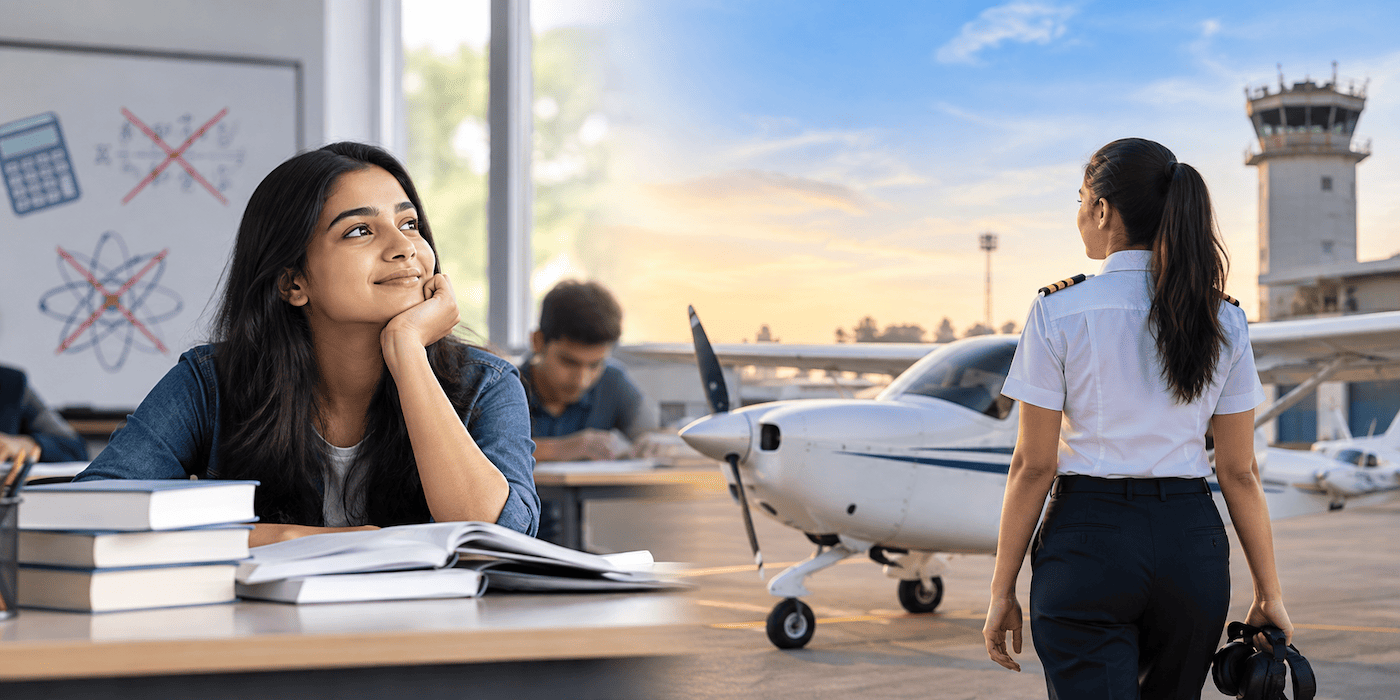
In 2025, that started to change. The DGCA moved to relax the Class 12 science requirement for CPL training, and...
If you’ve ever looked up at a plane and thought “I want to be up there,” you’re not alone. Ahmedabad has quietly become one of Gujarat’s better places to start that journey, and a growing number of students are choosing to train here instead of flying off to distant cities or countries for their first taste of the cockpit.
This guide walks you through exactly what it takes to get your Private Pilot License (PPL) in Ahmedabad — the eligibility rules, the training phases, the exams, the costs, and the timeline. Whether you’re a 12th-grader eyeing an aviation career, a working professional who’s always wanted to fly, or someone who just wants a weekend hobby that happens to involve an aircraft, this is the roadmap.
A Private Pilot License lets you fly an aircraft for personal or recreational use — no charging passengers, no commercial flying, just you and the sky. It’s issued by the Directorate General of Civil Aviation (DGCA), India’s aviation regulator, and it’s the first real license most pilots earn.
Here’s the part people often miss: a PPL isn’t just a hobby credential. It’s also the foundation for a Commercial Pilot License (CPL) if you decide later that you want to fly for an airline. Every hour you log, every exam you clear, and every skill you build during PPL training carries forward into CPL. So even if you’re not 100% sure you want a full aviation career yet, starting with a PPL keeps that door open without committing you to anything bigger than you’re ready for.
The eligibility bar for a PPL is lower than most people expect, which is part of why it’s such a good entry point.
Age: You need to be at least 16 to begin flight training and start logging hours, though the DGCA won’t actually issue you the Private Pilot License until you turn 17.
Education: A pass in Class 10 from a recognized board is generally enough to get started. You don’t need Physics and Maths at this stage — that requirement kicks in later if you go for a CPL.
Medical fitness: You’ll need a Class 2 Medical Certificate from a DGCA-approved medical examiner. This checks your vision, hearing, cardiovascular health, and general fitness to fly. It’s worth getting this done early — some students discover a correctable issue (like uncorrected vision) only after they’ve already enrolled, which can cause delays.
English proficiency: Since flying involves radio communication and technical documentation, you’ll need to read, write, and speak English comfortably.
A tip that we can’t stress enough: get your Class 2 medical sorted before you commit to a training program. It’s the one prerequisite that can quietly derail your plans if left for later.
Before you touch an aircraft, you’ll spend time in the classroom. DGCA requires you to clear theory papers in subjects like Air Navigation, Aviation Meteorology, and Air Regulations. These exams are conducted online through the DGCA’s Pariksha portal, and you’ll need a minimum passing score in each subject.
This phase is more than a formality. Understanding weather patterns, airspace rules, and navigation principles is what keeps you safe once you’re actually airborne. Good flight schools in Ahmedabad build this ground training around real scenarios — not just rote memorization — so it sticks when you need it in the cockpit.
Once your medical and ground exams are sorted, actual flying starts. PPL training typically involves around 40 to 50 hours of flight time, broken into a few categories:
This is where training in Ahmedabad has a practical edge. The city’s weather is generally flying-friendly for most of the year, and access to nearby airfields means students don’t lose too many training days to logistics.
Your first solo flight is the moment training stops feeling theoretical. It usually happens after 15-20 hours of dual instruction, once your instructor is confident you can handle the aircraft, the radio calls, and the decision-making on your own. Ask any pilot about their first solo and watch their face change — it’s a genuinely big deal, and it’s the point where most students stop doubting whether they made the right choice.
Alongside your flying hours, you’ll need to clear the DGCA theory exams if you haven’t already, and pass the Radio Telephony (RTR) exam, which certifies that you can communicate properly over aircraft radio. This isn’t just bureaucratic box-ticking — clear radio communication is genuinely one of the more nerve-wracking parts of early flying, and proper RTR prep makes a real difference on your check ride.
Once you’ve logged your required hours and cleared your exams, you’ll take a final flight test with a DGCA-designated examiner. Pass this, submit your paperwork through the eGCA portal, and your Private Pilot License gets issued. From here, you can legally fly solo for personal use — and if you want to go further, this is your launchpad into CPL training.
This is the question everyone asks, and the honest answer is: it depends more on you than on the school. Realistically, most students in Ahmedabad complete their PPL in 6 to 12 months.
A few things affect your timeline:
If you’re working or studying full-time, be realistic about pacing rather than rushing — flying is a skill that rewards steady, consistent practice over cramming.
Costs vary based on aircraft type, training hours needed, and what’s bundled into the course fee, but here’s a general breakdown of what you’re paying for:
A realistic all-in budget for a full PPL in India typically falls somewhere in the range of ₹8-15 lakhs, though this varies quite a bit depending on the school, aircraft, and how many additional flying hours you might need beyond the minimum. It’s worth asking any school for a clear, itemized breakdown upfront — vague “all-inclusive” pricing often hides extra costs that show up later.
A few practical reasons this city works well for PPL training:
Favorable flying conditions. Ahmedabad gets a good number of clear-sky days annually, which means fewer washed-out training sessions compared to coastal or hill-station locations.
Lower cost of living. Compared to metro hubs, day-to-day expenses (accommodation, food, local transport) are noticeably lighter on the wallet, which matters over a training period that can stretch past six months.
Growing aviation infrastructure. Gujarat has been investing in aviation and airport infrastructure, and Ahmedabad’s positioning as a regional aviation hub means more resources, more experienced instructors, and better ground support than you might expect.
Community. Training alongside a genuine cohort of aspiring pilots — not just a handful of scattered students — makes the theory classes, exam prep, and even the nervous pre-solo jitters a lot easier to handle.
Not all flight schools are built the same, and this decision matters more than people initially realize. When evaluating a school for your PPL training, look at:
Getting your Private Pilot License is genuinely a milestone worth celebrating, but for a lot of students, it’s also a starting point rather than a finish line. A few paths open up from here:
Getting a PPL isn’t complicated, but it does reward doing your homework — on eligibility, on school selection, and on realistic budgeting for time and money. Ahmedabad gives you a solid, well-supported place to do exactly that, with flying-friendly weather, reasonable costs, and a training ecosystem that’s been steadily growing.
If you’re serious about starting your PPL training in Ahmedabad, Infinifly Aviation Academy offers DGCA-aligned pilot training programs with experienced instructors and structured ground classes designed to take you from your first theory class to your first solo — and beyond, if a full aviation career is where you’re headed. Reach out to the team to talk through your eligibility, timeline, and next steps.
In 2025, that started to change. The DGCA moved to relax the Class 12 science requirement for CPL training, and...

It's the license that turns "First Officer" into "Captain." And if you're serious about commanding an airliner someday, understanding how...
The Airline Transport Pilot License is not something you casually add to your resume later - it's a career decision...