
Pilot Training Without Maths and Physics: What the 2025 DGCA Change Really Means
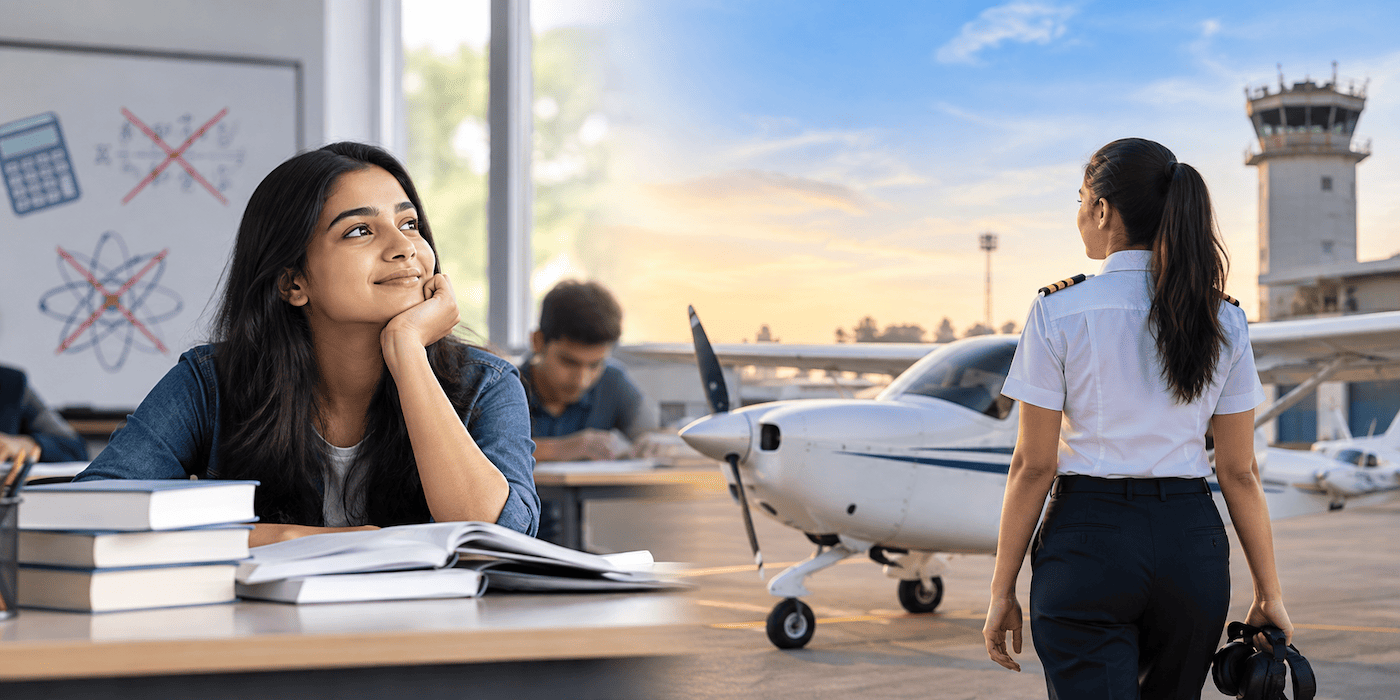
In 2025, that started to change. The DGCA moved to relax the Class 12 science requirement for CPL training, and...
If you’ve spent any time researching how to become a pilot in India, you already know the problem: everyone has an opinion, half the forums are outdated, and every academy’s website tells you their program is “the best.” What’s missing is someone who just answers the actual questions straight, without the sales pitch.
So that’s what this post is. We get asked these questions almost every week, from 17-year-olds who just finished their boards to working professionals thinking about a career switch. Some answers are simple. Some genuinely aren’t, and we’ll tell you when that’s the case. Either way, by the end of this you should have a much clearer picture of what DGCA pilot training actually involves, what it costs, and whether it makes sense for you.
DGCA stands for the Directorate General of Civil Aviation. It’s the government body that regulates civil aviation in India, and every licensed pilot flying in this country, from the guy doing joyrides in a Cessna to the captain of an Air India 787, holds a license issued or validated by the DGCA.
This matters because it means your training isn’t optional or a “nice to have” certificate. To fly commercially in India, you need a DGCA-issued Commercial Pilot License, and to get that, your ground school, flying hours, medical fitness, and exams all have to follow DGCA’s rules. There’s no shortcut around this. Any academy or training program you consider should be built specifically around DGCA requirements, not a generic international syllabus that you then have to convert later.
This is probably the most common question we get, and it usually comes with some anxiety attached, because the internet makes it sound complicated. It’s actually a fairly linear process once you understand the sequence:
Step 1: Class 1 Medical Certificate. Before you spend a rupee on flying, get medically assessed by a DGCA-approved examiner. This is non-negotiable and it’s the first thing that can disqualify someone, so do this early.
Step 2: Ground classes and CPL theory exams. You’ll study Air Navigation, Meteorology, Air Regulations, and Technical General/Specific. These are DGCA exams, not academy exams, so the quality of your ground school genuinely affects your pass rate.
Step 3: Flying training. DGCA requires a minimum of 200 hours of flight time to qualify for a CPL, including solo hours and cross-country flying. This is where most of your training timeline and budget goes.
Step 4: Skill test and license issuance. Once your hours and exams are done, a DGCA-designated examiner conducts your final flight test. Pass that, and your CPL gets issued.
Most students complete this whole journey in 18 to 24 months, assuming steady progress without long gaps. If you want the fuller breakdown with fees and eligibility criteria explained in detail, we’ve laid it out step by step in our guide to commercial pilot license requirements and DGCA exams in India.
The baseline requirements are set by DGCA, and they’re fairly consistent across the country:
One thing people often overlook: eyesight requirements are stricter than people assume, but corrective lenses are usually acceptable within limits. Don’t assume you’re disqualified because you wear glasses. Get the medical done and let the examiner tell you where you actually stand instead of guessing based on something you read online.
This trips up a lot of first-time researchers, so let’s clear it up plainly.
A Private Pilot License (PPL) allows you to fly an aircraft for personal, non-commercial reasons. You can’t get paid to fly, and you can’t work for an airline with just a PPL. It requires fewer flying hours and is often the first step people take, either because they want to test whether flying is really for them, or because they’re building toward a CPL anyway and the PPL is a natural early milestone. If you’re weighing whether to start there, our Private Pilot License program is designed exactly for that starting point.
A Commercial Pilot License (CPL) is what actually qualifies you to be paid to fly, whether that’s as a first officer at an airline, a charter pilot, or a cargo pilot. It requires significantly more flying hours, a deeper ground school syllabus, and a stricter medical standard.
There’s also the Airline Transport Pilot License (ATPL), which sits above the CPL and is what allows you to eventually become a captain and command an aircraft, once you’ve logged enough hours and experience post-CPL.
Most aspiring airline pilots go PPL to build early flying confidence, then move directly into CPL training since that’s the license that actually opens a paying career.
This is the question everyone wants a straight number for, and we’ll be honest with you: anyone who gives you one flat figure without asking about your training path is probably not telling you the whole picture.
CPL training in India typically runs into several lakhs of rupees, and the biggest variable is flying hours, since aircraft rental, fuel, and instructor time make up the bulk of the cost. Ground school, study materials, DGCA exam fees, medical assessments, and skill test fees add to that. Location matters too. Flying costs can vary depending on which flying club or airfield your academy is affiliated with.
What we’d actually encourage you to do is ask for a transparent, itemized breakdown from any academy you’re considering, not just a headline number. If you’re also weighing a PPL first, we’ve broken down realistic costs and eligibility for that route in our post on private pilot license cost and duration in India, and most academies, including ours, offer EMI options and guidance on financing, since paying it all upfront isn’t realistic for most families.
We obviously have a bias here, being based in Ahmedabad ourselves, so let’s give you the honest reasons rather than just saying “it’s great.”
Ahmedabad has favorable flying weather for most of the year, with relatively clear skies outside of monsoon season, which matters a lot for logging consistent flying hours without long weather-related delays. It’s also a growing aviation hub in Gujarat with decent airfield access and an increasingly active general aviation ecosystem.
Beyond the flying conditions, cost of living in Ahmedabad is meaningfully lower than in metro cities like Mumbai or Delhi, which matters if you’re relocating for 18-24 months of training. Housing, food, and daily expenses stretch further, and that adds up over a training period that long.
If you’re specifically comparing academies and want a ground-level look at what training here actually looks like month to month, we walked through the full journey in our roadmap on CPL training in Ahmedabad.
On paper, DGCA doesn’t mandate a fixed calendar duration, only the hours and exams you need to complete. In practice, most students finish their CPL in 18 to 24 months.
The variables that stretch or shrink this timeline: how quickly you clear your ground exams (some students need multiple attempts, which is normal and not something to be embarrassed about), weather patterns that affect flying schedules, aircraft and instructor availability at your training academy, and how consistently you’re able to show up and fly rather than pausing for months at a time.
If someone tells you they’ll get you licensed in six months, ask hard questions. It’s not physically impossible in ideal conditions, but it’s rare, and rushing flying hours isn’t something you want to optimize for anyway. This is a skill you’re building, not just a box you’re checking.
No, but you do need Physics and Mathematics at the 10+2 level, since those are DGCA’s baseline academic requirements. Beyond that, you don’t need an engineering degree, a science background beyond 12th grade, or any prior aviation exposure.
We’ve trained students who came from commerce backgrounds after redoing their 12th with PCM, career-switchers in their late twenties who worked in completely unrelated fields, and students straight out of school with zero flying experience. What actually predicts success in training isn’t your academic pedigree, it’s discipline, consistency in ground study, and genuine comfort with the physical and mental demands of flying.
Getting your CPL is a major milestone, but it’s the beginning of your career, not the end of the process. Fresh CPL holders typically look at a few paths:
Airline hiring cycles fluctuate with the broader aviation industry, so it helps to go in with realistic expectations about the first year or two after licensing. Building hours, getting a type rating, and possibly starting with a smaller operator before an airline is a completely normal path, not a failure to “make it.”
Since this is likely the biggest decision point for anyone reading this far, here’s what we’d genuinely tell a friend to check:
Our Commercial Pilot License program is built around exactly these principles, with a DGCA-aligned structure across ground school, simulator training, and flying hours, but honestly, use this checklist wherever you end up training. It’ll serve you well.
We’d be doing you a disservice if we just said “yes, absolutely” without context, so here’s the honest picture. Indian aviation has been on a genuine growth trajectory, with airlines expanding fleets and domestic air travel increasing steadily. That translates to real long-term pilot demand.
That said, this is a career that requires real financial investment upfront, genuine discipline through a demanding training period, and some tolerance for the fact that hiring cycles in aviation aren’t always linear. It rewards people who go in clear-eyed about both the upside and the effort involved.
If you’re drawn to it because you actually want to fly, not just because you heard it pays well, that’s usually the person who makes it through training and enjoys the career on the other side.
That’s completely normal. Every aspiring pilot’s situation is a little different, whether it’s about financing options, comparing PPL versus jumping straight to CPL, or just wanting to see the training facilities before committing to anything. Reach out to us directly and we’ll walk you through it without any pressure to decide on the spot.
In 2025, that started to change. The DGCA moved to relax the Class 12 science requirement for CPL training, and...
An aviation career after 12th isn't reserved for a lucky few with connections or unlimited money. Whether you dream of...

This guide breaks down exactly what the DGCA ATPL exams cover, how to structure your study time, and what actually...